

TL;DR:
- Commercial drain servicing involves regular cleaning, inspection, and repairs for high-usage systems.
- It is essential for compliance, preventing costly blockages, and avoiding operational shutdowns.
- Preventative maintenance significantly reduces emergency calls and long-term expenses.
A single blocked drain can shut down a commercial kitchen, trigger a health inspection, and cost thousands in lost trade before the end of the working day. Many business owners in Reading and the surrounding area underestimate how quickly a drainage issue can escalate from a slow-running sink to a full operational shutdown. Commercial drain servicing is the professional maintenance, cleaning, inspection, and repair of drainage systems in business premises, and it is fundamentally different from anything a residential plumber would handle. This guide covers what servicing involves, how it differs from home systems, how often you need it, and what to look for in a provider.
Table of Contents
- What is commercial drain servicing?
- Key differences: commercial vs residential drain systems
- Common issues and how expert servicing prevents disruption
- How often should commercial drains be serviced?
- Why preventative drain servicing outperforms emergency calls
- Need reliable commercial drain servicing in Reading?
- Frequently asked questions
Key Takeaways
| Point | Details |
|---|---|
| Business-grade expertise | Commercial drain servicing handles complex drainage needs that go beyond home systems. |
| Prevention saves money | Routine maintenance prevents costly blockages and business disruption. |
| Frequency matters | Most businesses need regular quarterly servicing but high-usage venues need more frequent checks. |
| Choose experienced providers | Professional servicers know compliance rules and use effective tools like hydro jetting and CCTV surveys. |
What is commercial drain servicing?
Building on the introduction, let's break down the fundamentals of commercial drain servicing and its core components.
Commercial drain servicing refers to the routine and emergency maintenance, cleaning, repair, and inspection of drainage systems in business premises and multi-unit buildings. Unlike a household drain that carries relatively modest volumes of water and waste, a commercial system must cope with continuous, heavy use across multiple outlets simultaneously. The complexity is significantly greater, and the consequences of failure are far more serious.
The types of properties that rely on commercial drain servicing include restaurants and food preparation facilities, office blocks, shopping centres, hotels, factories, and healthcare buildings. Each of these environments generates different types of waste and places different demands on the drainage infrastructure. A restaurant kitchen, for example, produces enormous quantities of fats, oils, and grease every single day. A manufacturing site may discharge industrial effluent that requires specialist interceptor maintenance.
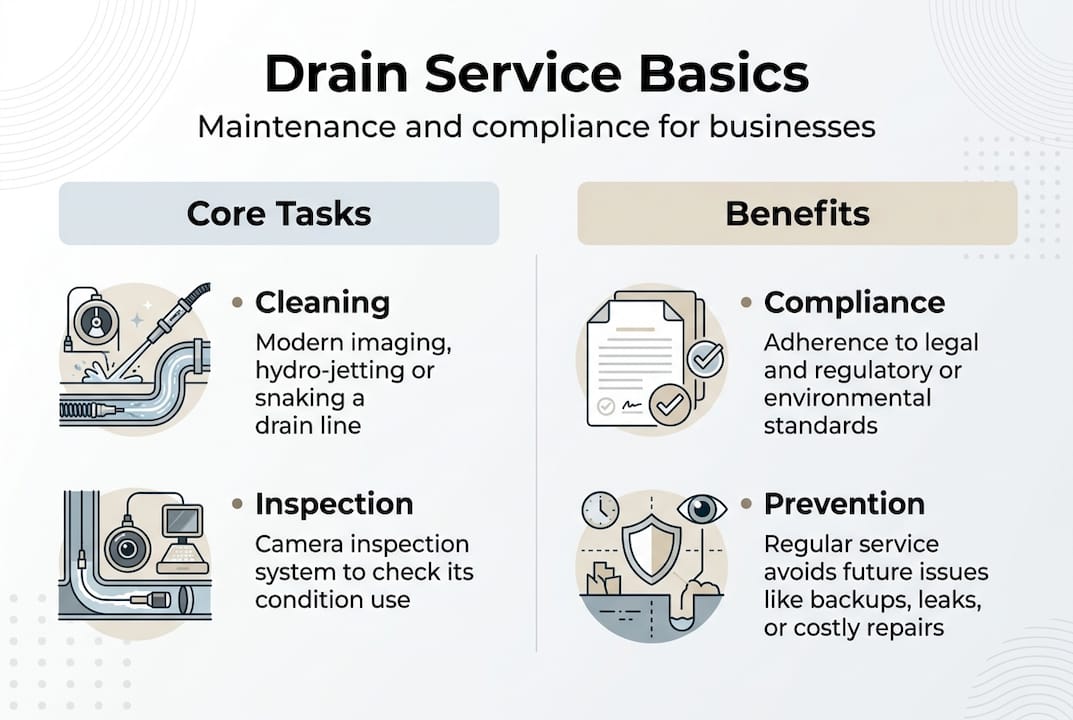
Typical tasks carried out during a commercial drain service include:
- Hydro jetting: using high-pressure water to clear blockages and clean pipe walls thoroughly
- CCTV drain surveying: inserting a camera into the drain to identify cracks, root ingress, or blockage locations
- Grease interceptor and trap maintenance: removing accumulated fats and solids that would otherwise cause major blockages
- Blockage removal: clearing obstructions caused by debris, foreign objects, or build-up
- Pipe repair and relining: fixing structural damage without unnecessary excavation
Regular servicing is not just good practice; it is often a legal and compliance requirement. Businesses must demonstrate that their drainage systems are maintained to a standard that prevents environmental contamination and public health risks. Accessing common drainage services from a qualified specialist ensures your business meets these obligations without disruption to daily operations.
Key differences: commercial vs residential drain systems
Understanding what commercial servicing is, it's crucial to see how business drains diverge from the ones at home.
The gap between a residential drain and a commercial one is not simply a matter of scale. It is a difference in design, regulation, materials, and maintenance philosophy. Commercial systems use larger pipes, often up to 6 inches in diameter, handle significantly higher volumes, enforce stricter regulatory codes, and require components such as grease traps that simply do not exist in domestic settings.
Here is a direct comparison to illustrate the key differences:
| Feature | Residential | Commercial |
|---|---|---|
| Pipe diameter | Typically 4 inches | Up to 6 inches or more |
| Daily usage volume | Low to moderate | High to very high |
| Grease traps required | Rarely | Almost always (food premises) |
| Regulatory inspections | Infrequent | Mandatory and scheduled |
| Maintenance frequency | As needed | Quarterly or more often |
| Backflow prevention | Basic | Advanced, tested regularly |
From a regulatory standpoint, commercial premises in England must comply with building regulations and environmental legislation that govern how drainage systems are installed, maintained, and inspected. Backflow prevention devices, which stop contaminated water from flowing back into the clean supply, must be tested at regular intervals. Interceptors, which capture oils and sediment before they enter the sewer network, must be pumped out on a documented schedule.
Restaurants and hospitality businesses face the strictest requirements of all. Grease accumulates rapidly in kitchen drains, and without scheduled drain surveys and interceptor maintenance, blockages can occur within weeks rather than months.
Pro Tip: Always ask your drainage contractor for written evidence of compliance, including service reports, interceptor pump-out records, and any CCTV survey footage. This documentation protects you during insurance claims and environmental inspections.
Using a residential-grade service on a commercial system is a false economy. Domestic engineers are not equipped with the tools, knowledge, or insurance to handle commercial-grade infrastructure. If something goes wrong, your business insurance may not cover the damage.
Common issues and how expert servicing prevents disruption
With those differences clear, here's why skipping regular servicing leads to real-world problems, and how experts keep drains trouble-free.
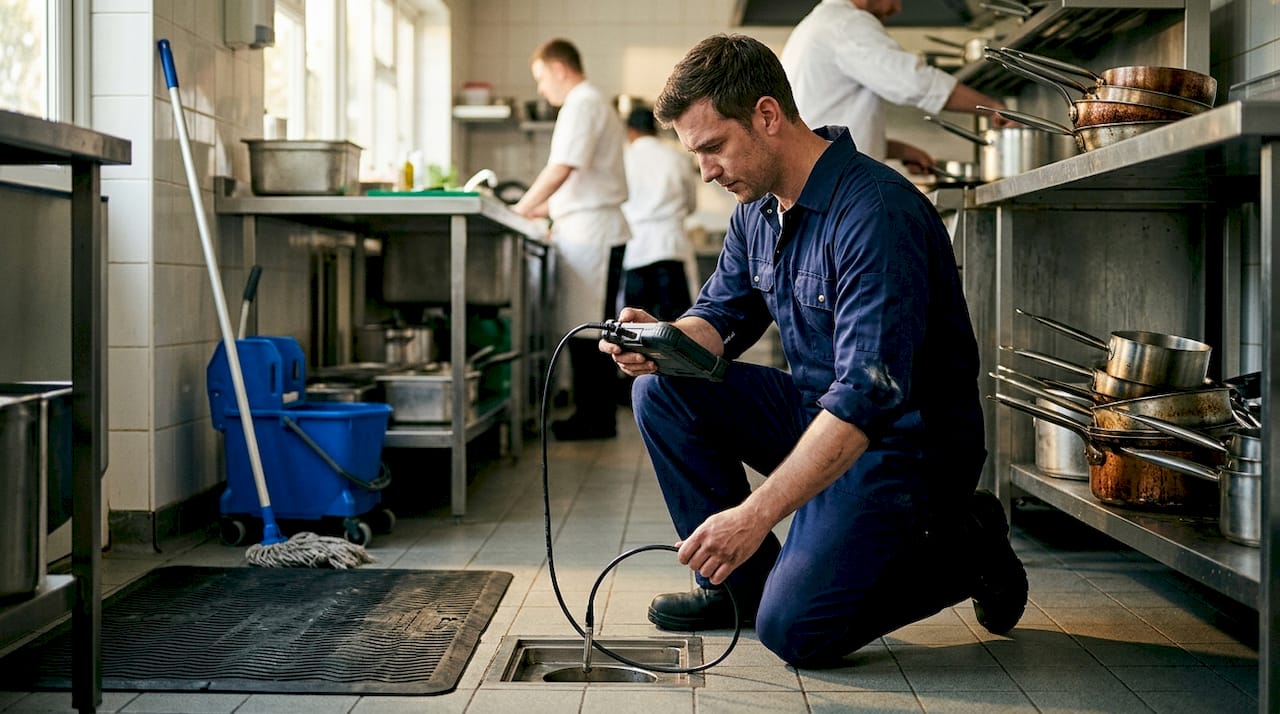
The most frequent causes of commercial drainage failure are predictable and, crucially, preventable. Knowing what to watch for helps you understand why a proactive servicing schedule is worth every penny.
Common causes of commercial drain problems include:
- Fats, oils, and grease (FOG) build-up: the leading cause of blockages in food service environments
- Scale and mineral deposits: particularly in hard water areas like much of Berkshire
- Debris and foreign objects: wet wipes, paper products, and packaging that should never enter drains
- Root ingress: tree roots exploiting small cracks in older pipework
- Structural collapse: deterioration of ageing pipe materials under heavy load
The outcomes of neglect are severe. Internal flooding damages stock, equipment, and premises. Unplanned shutdowns cost trading revenue and damage customer trust. In food businesses, a drainage failure can trigger an environmental health visit and a temporary closure notice.
"Preventative drain maintenance has been shown to reduce blockages by 80 to 95 percent, with documented cases recording zero blockages following a consistent maintenance programme."
In one documented case, a commercial kitchen that switched from reactive to preventative servicing saved an estimated £15,000 annually by avoiding emergency call-outs, pipe repairs, and lost trading days. That figure does not include the less visible costs: staff disruption, reputational damage, and the management time spent dealing with crises.
Hydro jetting is one of the most effective tools available. It restores full bore flow to pipes that have been narrowed by years of grease and scale accumulation. Combined with CCTV inspection, it gives engineers a clear picture of the system's condition before problems become emergencies.
Businesses in sectors like healthcare, hospitality, and food manufacturing should build routine drain maintenance into their operational calendar, not treat it as an afterthought. For businesses already experiencing issues, drain unblocking solutions can address immediate problems while a longer-term maintenance plan is established.
How often should commercial drains be serviced?
You now know what problems regular servicing prevents, so how often should your type of business actually book it?
Servicing frequency depends on the nature of your business, the volume of waste your drains handle, and your local regulatory requirements. There is no single answer, but the following table provides evidence-based guidance for the most common commercial settings.
| Business type | Recommended frequency | Key reason |
|---|---|---|
| Restaurant or café | Quarterly minimum | High FOG output, grease traps |
| Hotel or hospitality | Every 3 to 4 months | Mixed kitchen and guest waste |
| Office building | Twice yearly | Lower volume, standard waste |
| Retail premises | Twice yearly | Moderate use, seasonal peaks |
| Manufacturing or industrial | Monthly to quarterly | Specialist effluent, high volume |
| Healthcare facility | Quarterly or more | Hygiene compliance, high risk |
Quarterly servicing is the benchmark for restaurants, with grease interceptors often requiring pump-outs every 30 to 90 days depending on output volume. Missing these intervals is one of the most common and costly mistakes food business operators make.
To build a proactive maintenance schedule that actually works, follow these steps:
- Audit your current system: understand pipe sizes, interceptor locations, and the last service date
- Map your risk areas: identify which outlets carry the heaviest load or most problematic waste
- Set calendar reminders: schedule servicing well in advance, not reactively
- Keep a maintenance log: record every service, survey, and repair with dates and engineer reports
- Review annually: adjust frequency based on any issues identified during the previous year
Pro Tip: Preventative contracts with a drainage specialist typically cost less per visit than emergency call-outs, and many providers offer priority response as part of the agreement. Booking recommended drain service intervals in advance locks in your schedule and often your pricing too.
Why preventative drain servicing outperforms emergency calls
Having laid out practical guidance, here is a perspective built on local business realities and what really works.
There is a persistent belief among some business owners that drain servicing is only necessary when something goes wrong. It is understandable. Maintenance budgets are tight, and an invoice for a service that appears to have solved nothing visible feels hard to justify.
But this thinking misses the true cost of a drainage emergency. It is not the engineer's invoice. It is the Saturday lunch service you had to cancel, the environmental health officer standing in your kitchen, the insurance claim that takes weeks to resolve, and the reviews left by customers who witnessed the chaos. These are the costs that do not appear on a drainage invoice but are very real.
Prevention also protects your team. Staff working in a premises with recurring drain problems face unnecessary stress, unpleasant conditions, and disrupted routines. That has a direct impact on morale and retention, neither of which is cheap to fix.
From our experience working with businesses across Reading and Berkshire, the operations that run most smoothly are the ones that treat drainage as infrastructure, not as an emergency service. Reviewing [local prevention case studies](https://777drains.co.uk/blog/f/blocke#Blocked Drain in Reading) shows clearly that consistent maintenance is the single most reliable way to protect your premises, your reputation, and your bottom line.
Need reliable commercial drain servicing in Reading?
For those ready to put theory into practice, here is how to get professional support tailored to Reading businesses.
At 777 Drains, we work with restaurants, offices, retail premises, and commercial landlords across Reading and the surrounding area. Our engineers respond fast, arrive equipped, and leave your system fully documented and compliant.

Whether you need to book a commercial drain service on a scheduled basis or require 24hr drain repairs Reading for an urgent situation, our team is ready to help. Transparent pricing, full compliance documentation, and no unnecessary call-outs. Visit the expert local drainage team at 777 Drains to discuss a servicing plan built around your business needs.
Frequently asked questions
How does commercial drain servicing differ from residential?
Commercial drains use larger pipes, handle significantly more waste, and are subject to stricter maintenance schedules and compliance requirements than residential systems.
How often should we service restaurant drains?
Restaurants should service drains quarterly at minimum, with grease interceptors often requiring pump-outs every 30 to 90 days depending on kitchen output.
What types of businesses need the most frequent drain servicing?
Restaurants, hotels, hospitals, and any business with high-volume kitchens or food preparation areas need the most frequent servicing, as quarterly service prevents costly blockages in these environments.
What is hydro jetting and why is it used?
Hydro jetting uses high-pressure water to clear blockages and clean pipe walls thoroughly. It is particularly effective because it restores full bore flow and removes stubborn grease and scale build-up.
Can regular servicing really prevent emergencies?
Yes. Documented maintenance programmes have recorded zero blockages post-maintenance, demonstrating that routine inspections and cleaning reduce costly emergencies to near zero.