
TL;DR:
- Pipe material choice significantly influences drainage lifespan, flow efficiency, and ground movement tolerance.
- PVC and HDPE are preferred for modern homes due to durability, flexibility, and environmental benefits.
- Regular inspections and proper installation are essential to prevent costly drainage system failures.
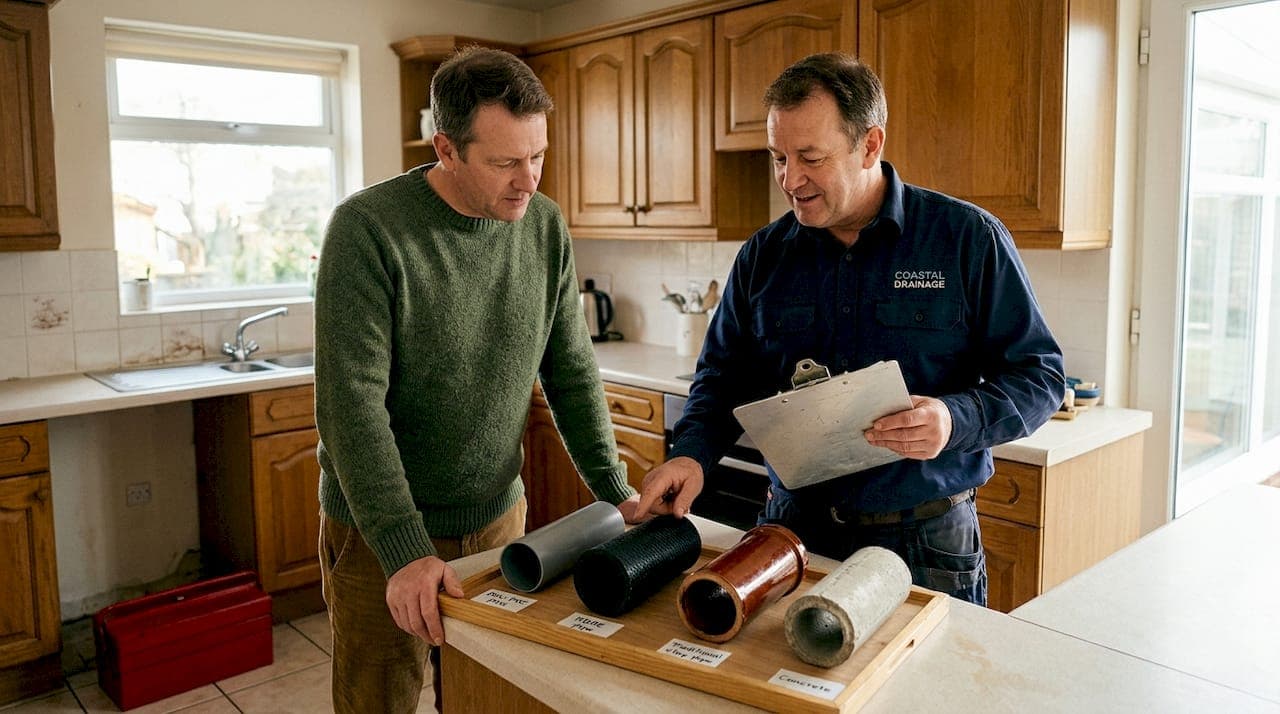
Most homeowners assume a drain is a drain. You dig a trench, drop in a pipe, cover it up, and the water goes away. That belief is exactly how properties in Reading end up with recurring blockages, cracked pipes, and expensive emergency call-outs. The material your drainage pipe is made from affects everything: how well water flows, how long the system lasts, and whether tree roots or shifting ground will cause problems five years down the line. Reading's variable soils, including heavy clay in many residential areas, make this choice even more consequential. This guide breaks down the main materials, what they do well, and how to choose the right one for your specific property.
Table of Contents
- What are the main drainage pipe materials?
- How material choice affects drainage system performance
- Installation and maintenance best practices
- Making the right decision for your property
- Our take: Why pipe choice matters more than most realise
- How 777 Drains can help you choose and maintain the right drainage pipes
- Frequently asked questions
Key Takeaways
| Point | Details |
|---|---|
| PVC and HDPE last longest | Plastic drainage pipes typically provide lifespans up to 100 years with minimal maintenance. |
| Material affects performance | Choosing the right pipe impacts blockages, flow, and resistance to local ground shifts. |
| Maintenance is essential | Annual inspections and proper installation prevent costly issues down the line. |
| HDPE suits Reading soils | Flexible HDPE pipes are best for Reading’s common clay soils due to their adaptability. |
| Expert installation saves money | Professional help ensures your drainage system works reliably for decades. |
What are the main drainage pipe materials?
British drainage systems rely on four main pipe materials: PVC (polyvinyl chloride), HDPE (high-density polyethylene), clay, and concrete. Each has a distinct purpose, and understanding the differences will save you from costly mistakes.
PVC is the most widely used material in modern residential drainage. It is lightweight, easy to cut and join, and its smooth interior surface allows water to move quickly without debris catching. PVC pipes are corrosion-resistant with a lifespan of 50 to 100 years, making them a solid long-term investment for most homes. The trade-off is that PVC becomes brittle in very cold conditions and should not be used where heavy vehicle loads will pass directly overhead.
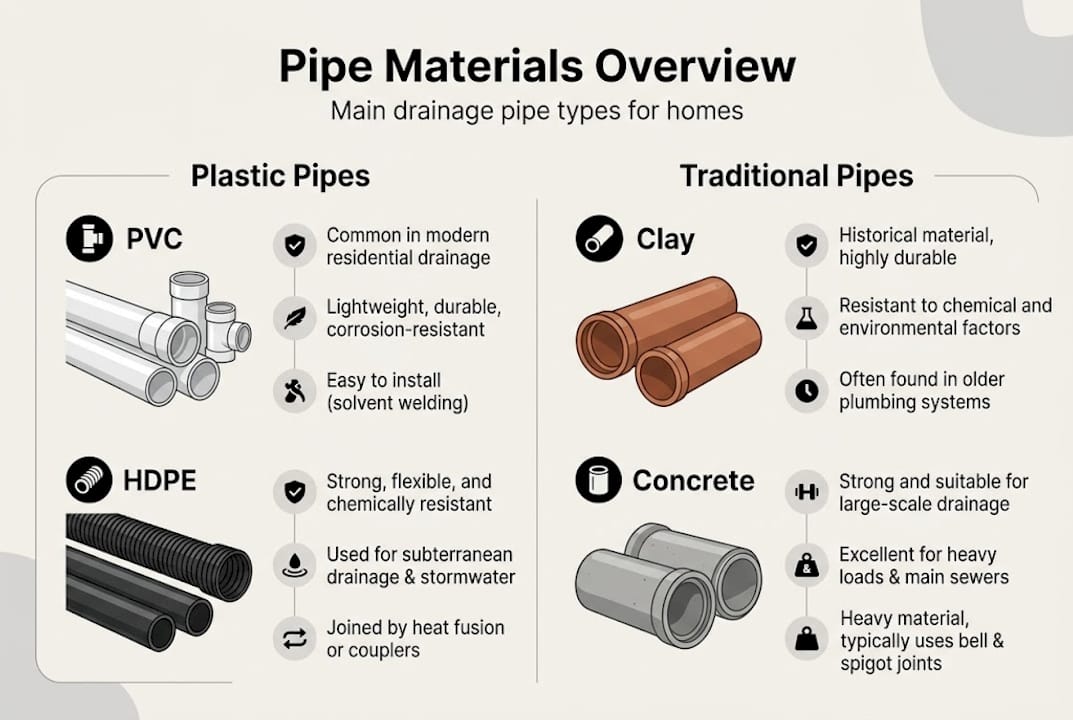
HDPE is the flexible alternative. Where PVC is rigid, HDPE bends without cracking, which makes it well suited to ground that shifts or settles. HDPE pipes offer chemical and UV resistance with a lifespan matching PVC at 50 to 100 years, though corrugated versions can collect debris inside their ridges over time.
Clay pipes are the traditional choice and still found beneath many older Reading properties. They are dense, heavy, and resistant to chemical attack from ground contaminants. However, they are brittle, expensive to transport, and the joints can fail as ground moves, letting in root intrusion.
Concrete pipes are used in large-scale commercial or highway drainage where structural strength is the priority. They are rarely the right choice for domestic gardens or drives.
Here is a quick comparison to help you see the differences at a glance:
| Material | Lifespan | Weight | Flexibility | Best use |
|---|---|---|---|---|
| PVC | 50-100 years | Light | Rigid | Residential drainage |
| HDPE | 50-100 years | Light | Flexible | Unstable or clay soils |
| Clay | 50-100 years | Heavy | Brittle | Older properties |
| Concrete | 50+ years | Very heavy | Rigid | Commercial/highway |
When choosing between drainage pipe types, consider these key factors:
- Soil type beneath and around your property
- Whether vehicle traffic will pass over the pipe
- Proximity of trees and their root systems
- Budget for materials and installation labour
- Whether you are replacing existing pipes or starting fresh
How material choice affects drainage system performance
Once you understand what each material is made of, the next question is how that translates to real-world performance under your garden or driveway.
Flow rate is the first consideration. Smooth-bore pipes, whether PVC or HDPE, allow water to travel quickly with minimal friction. Smooth interiors promote excellent flow, and HDPE's heat-fused joints eliminate the gaps where leaks start in gasketed systems. Corrugated HDPE, often used in French drains, trades some flow efficiency for flexibility and permeability.
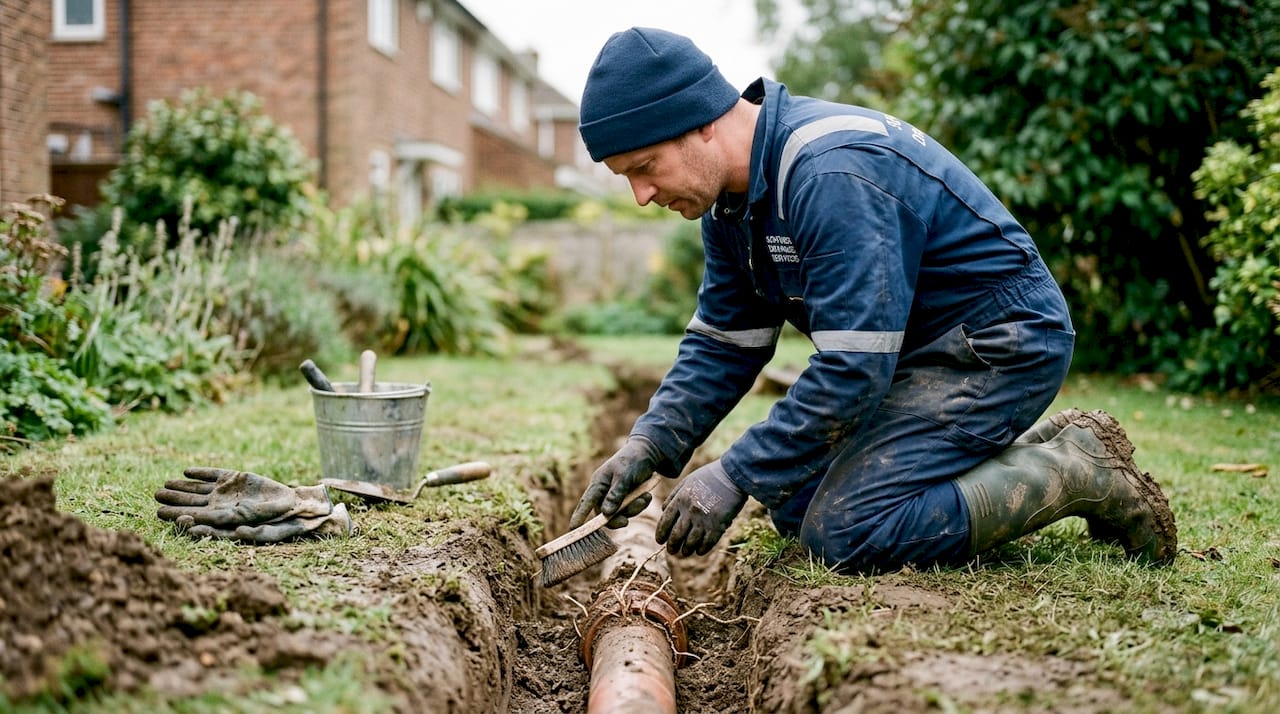
Reading sits on a mix of chalk and heavy clay geology. Clay soils expand when wet and contract when dry, which creates ground movement that rigid, gasketed pipe joints struggle to accommodate. HDPE's flexibility means it moves with the ground rather than cracking under the pressure. This is one reason we see so many failed clay pipe joints in older Reading properties after a wet winter.
Root intrusion is another major risk. Tree roots seek out moisture and will exploit any gap in a pipe joint. Clay pipes with deteriorating mortar joints are particularly vulnerable. PVC and HDPE with properly sealed joints offer far better resistance, though no pipe is entirely immune if a joint fails.
For French drain installations, use 4-inch perforated PVC or corrugated HDPE wrapped in geotextile fabric to prevent fine soil particles from blocking the perforations. This combination balances permeability with protection.
Here is how the materials compare on performance factors:
| Factor | PVC | HDPE | Clay | Concrete |
|---|---|---|---|---|
| Flow efficiency | Excellent | Excellent | Good | Good |
| Ground movement tolerance | Poor | Excellent | Poor | Poor |
| Root resistance | Good | Good | Poor | Moderate |
| Chemical resistance | Good | Excellent | Excellent | Moderate |
For properties in areas with known ground movement issues, managing blockages locally often starts with identifying whether the pipe material is contributing to the problem. The Reading drainage challenges we encounter most frequently trace back to clay pipes installed decades ago, now failing at the joints.
Here is a practical order of checks when assessing your drainage system:
- Identify the pipe material currently in use (a CCTV survey will confirm this)
- Check for visible joint gaps, cracks, or root intrusion
- Assess soil type and whether ground movement is likely
- Evaluate proximity of mature trees
- Decide whether repair or full replacement is the better long-term option
Pro Tip: If you notice slow drainage after heavy rain rather than a complete blockage, the problem is often a partial joint failure rather than a full obstruction. A CCTV inspection will pinpoint it quickly.
Installation and maintenance best practices
Knowing which pipe to choose is only half the job. How it is installed and maintained determines whether it performs well for decades or causes problems within a few years.
For a French drain, the installation sequence matters enormously:
- Dig a trench at least 300mm wide and to the depth required by your drainage plan
- Lay a gradient of at least 1% (1cm drop per metre of run) to ensure flow
- Line the trench with geotextile fabric before adding gravel
- Place the perforated pipe on a gravel bed, perforations facing downward
- Wrap the fabric over the top of the gravel before backfilling
- Compact the backfill carefully to avoid disturbing the pipe gradient
Skipping the geotextile fabric is one of the most common installation errors we see. Without it, fine soil particles migrate into the gravel and eventually block the pipe perforations entirely.
"Annual inspections, clearing debris, and addressing root intrusion in clay or plastic pipes are essential. In fine soils, use socked pipe to prevent silting."
This advice from drainage specialists reflects what we see on the ground every year. Annual inspections and debris clearing are the single most effective way to extend the life of any drainage system. It takes far less time and money to clear a partial blockage than to excavate and replace a failed pipe.
For maintenance for domestic drains, the annual checklist should include:
- Clearing leaves and debris from gully inlets and outlets
- Flushing the system with clean water to shift any sediment
- Checking visible inspection chambers for signs of root intrusion or joint movement
- Looking for wet patches in the garden that might indicate a leaking pipe
Drainage system inspections using CCTV cameras are the most reliable way to assess what is happening inside pipes that you cannot see. We recommend one every three to five years for older properties, or immediately after any significant ground movement or tree removal.
Pro Tip: If you have had a large tree removed recently, book a CCTV inspection within six months. Root systems do not disappear immediately, and dying roots can cause blockages as they decompose inside the pipe.
Making the right decision for your property
With all the information in front of you, the final step is applying it to your specific situation. No single pipe material is universally correct. The right choice depends on a combination of factors that are unique to your property.
Work through this checklist before making any decision:
- Soil type: Clay soils demand flexible HDPE; chalk or sandy soils suit rigid PVC well
- Traffic loading: If vehicles will cross the pipe route, use concrete-encased or specifically rated pipe
- Tree proximity: Within 3 metres of mature trees, prioritise sealed-joint systems and consider root barriers
- Chemical exposure: Near fuel storage or industrial areas, HDPE's superior chemical resistance is essential
- Budget: PVC is generally cheaper to purchase and install; HDPE costs more but may save money long-term in unstable ground
- Access for maintenance: Longer runs with fewer bends are easier to inspect and clear
On sustainability, the environmental case for plastic pipes is stronger than many people realise. Plastic pipes produce 26 to 67% lower transport emissions compared to concrete, and HDPE's heat-fused joints eliminate the need for chemical solvents during installation. For properties where environmental impact matters, this is a meaningful advantage.
For expert advice for local properties in Berkshire, the general guidance is: choose PVC for straightforward residential drainage in stable ground, and HDPE wherever soil movement, chemical exposure, or long-term flexibility is a concern. Clay and concrete remain relevant only in specific legacy or commercial contexts.
Our take: Why pipe choice matters more than most realise
After years of responding to drainage emergencies across Reading and Berkshire, we have noticed a pattern. Most call-outs that seem like simple blockages turn out to be the result of a poor material choice made years earlier. A homeowner chose the cheapest pipe available, or a builder used whatever was on the lorry that day, and now the system is failing in ways that are expensive to fix.
Conventional advice focuses on upfront cost. We understand the appeal. But the hidden costs of the wrong material, secondary blockages, root damage, early joint failure, and the disruption of excavating a garden or driveway, far outweigh any initial saving. How we solve drain issues often begins with undoing a decision made at installation.
Local knowledge genuinely matters here. Reading's clay-heavy geology behaves differently from sandy soils in other parts of the country. A drainage engineer who works in this area every day understands that in a way a generic guide simply cannot replicate.
How 777 Drains can help you choose and maintain the right drainage pipes
Choosing the right drainage pipe material is genuinely important, and getting it wrong is an expensive lesson. At 777 Drains, we work with homeowners and property managers across Reading and Berkshire every day, helping them make the right call from the start.

Our full drainage services cover everything from material selection advice and professional installation through to 24/7 emergency repairs when something goes wrong. If you are unsure what is already in the ground, our CCTV drain surveys give you a clear picture before you commit to any work. For urgent issues or to book an inspection, our Reading emergency drainage support team is ready to respond quickly and with minimal disruption to your property.
Frequently asked questions
How long do different drainage pipe materials last?
PVC and HDPE pipes last 50 to 100 years, though actual lifespan depends heavily on soil conditions, installation quality, and how well the system is maintained. Clay can last a similar period but is far more vulnerable to joint failure as ground shifts.
What is best for clay soils in Reading?
HDPE is the strongest choice for Reading's clay soils because its flexibility allows it to move with the ground without cracking or losing joint integrity. HDPE excels in ground movement, making it significantly more reliable than rigid alternatives in this geology.
How often should I check and clean my drainage pipes?
Annual inspections and clearing debris are the minimum recommended maintenance for any drainage system. Flush pipes with clean water, clear gully inlets, and book a CCTV survey every few years to catch problems early.
Is plastic better than clay or concrete for most homes?
For the vast majority of residential properties, yes. PVC and HDPE are lighter, easier to install, longer-lasting in modern conditions, and plastic pipes produce 26 to 67% lower transport emissions than concrete, making them the practical and increasingly sustainable default choice.