
TL;DR:
- Local drainage systems like gullies and soakaways are crucial in preventing household flooding.
- Proper maintenance of drains significantly reduces flood risk and should be done annually.
- Sustainable Drainage Systems (SuDS) manage water at source, easing pressure on main waterways.
Most people assume flooding is stopped by massive river barriers or government flood schemes. The reality is far more local than that. Your drains, your driveway, and your garden soakaway are often the first and most decisive line of defence against flood damage. In the Thames Valley, where saturated ground and high groundwater are a persistent challenge, the difference between a dry living room and a ruined one can come down to whether your gutters and gullies are clear. This guide gives you a practical, no-nonsense understanding of how drainage works, what choices you have as a homeowner, and how to keep your system performing when it matters most.
Table of Contents
- Why drains matter in the Thames Valley
- How drains control flood risk: Key principles
- Choosing and installing drainage for your home
- Maintenance: The critical weak link in flood protection
- What most guides miss: Small drains, big difference
- Get expert help with flood prevention and drainage
- Frequently asked questions
Key Takeaways
| Point | Details |
|---|---|
| Drains are flood prevention frontline | Well-designed home drains play a critical role in soaking up and redirecting stormwater before it becomes a flood risk. |
| Testing and planning matter | Matching the drainage type to your soil and site ensures the best flood resilience and compliance with regulations. |
| Maintenance prevents disasters | Routine inspections and cleaning protect both your home and the wider neighbourhood from dangerous blockages. |
| Climate-ready design is essential | Modern systems must handle unpredictable heavy rains brought by climate change to remain effective for the long term. |
Why drains matter in the Thames Valley
The Thames Valley has a well-documented relationship with flooding. After prolonged rainfall, the catchment saturates quickly, rivers rise, and surface water has nowhere to go. What many homeowners do not realise is that recent Thames flooding events have been worsened not just by river levels, but by overwhelmed local drainage networks struggling to cope with runoff.
Large flood defences protect riverbanks and town centres. But they cannot help if the water never reaches the river in the first place because it is pooling in your street, your garden, or your neighbour's basement. That is where your domestic drainage overview becomes critical. Every blocked gully, every silted soakaway, and every impermeable surface adds to the volume of water that the public system must absorb.
Here is why local drainage deserves your attention:
- Saturated ground means rain cannot soak away naturally, so engineered drainage carries the load
- Blocked or undersized drains create localised ponding that backs up into properties
- Surface water flooding is now the most common type of flooding in urban areas
- Older drainage infrastructure in many Thames Valley towns was not designed for modern rainfall intensity
- Newbury drain risks and similar local challenges show how quickly small blockages escalate
Sustainable Drainage Systems (SuDS) manage surface water runoff close to its source, reducing pressure on sewers and rivers. This is not just a planning concept. It is a practical toolkit for homeowners who want to protect their property.
One factor that makes the Thames Valley particularly tricky is the geology. High groundwater reduces infiltration feasibility, meaning that solutions relying on water soaking into the ground simply do not work in many parts of the region. Above-ground and slow-release systems are often the only viable option.
"In the Thames Valley, the question is rarely whether flooding will occur, but whether your drainage is ready to manage it when it does."
Understanding this local context shapes every decision you make about drainage, from the type of system you install to how often you maintain it.
How drains control flood risk: Key principles
With an understanding of local flood challenges, let us look at the central principles behind how drains truly prevent flooding. The core idea is simple: slow the water down, store it temporarily, and release it gradually. The problems begin when drainage systems do the opposite, rushing water into already-overloaded networks.
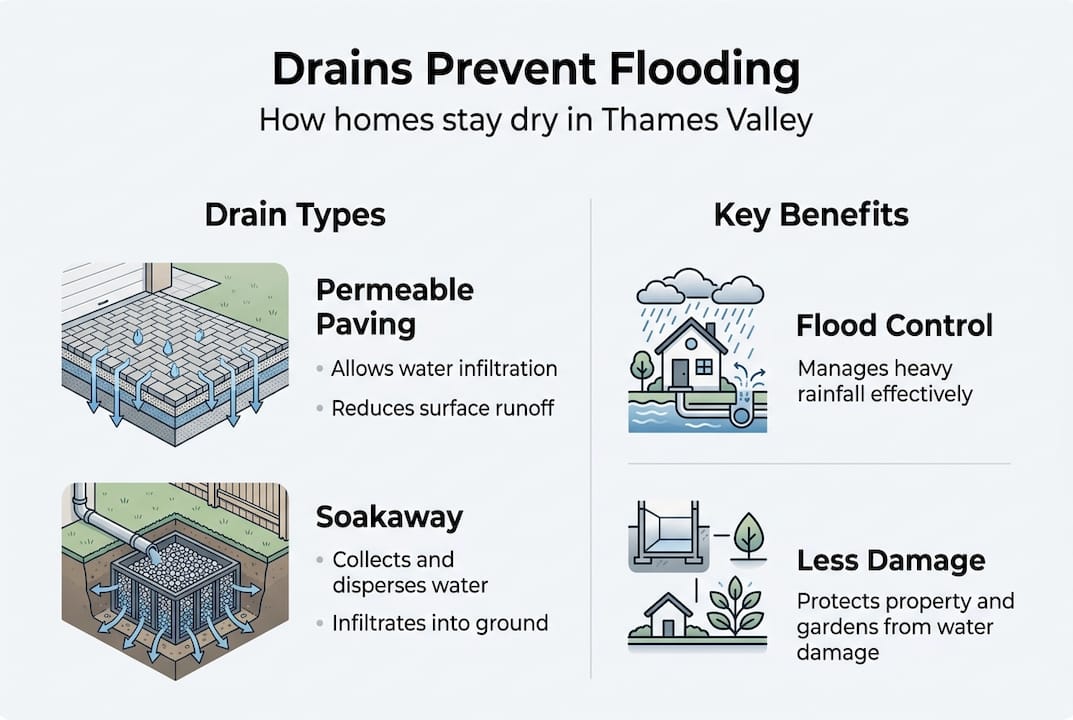
Traditional drainage pipes water away as fast as possible. SuDS take the opposite approach, mimicking how natural landscapes handle rain. Here is a comparison of the two approaches:
| Feature | Traditional drainage | SuDS approach |
|---|---|---|
| Water speed | Fast discharge | Slow and controlled |
| Storage | Minimal | Built-in attenuation |
| Pollution control | Limited | Filtered through soil or media |
| Climate resilience | Often inadequate | Designed with climate uplift |
| Maintenance needs | Periodic jetting | Regular but straightforward |
The key mechanisms at work in effective drainage are:
- Attenuation — holding water in ponds, swales, or permeable surfaces before releasing it slowly
- Infiltration — allowing water to soak into the ground where conditions permit
- Conveyance — moving water safely through channels and pipes without surcharging
- Treatment — removing pollutants before water enters watercourses
SuDS limit discharge to greenfield runoff rates and are designed for large storms with climate change uplifts built in. This is the regulatory benchmark for new drainage schemes in England, and it reflects how seriously engineers now take the risk of extreme rainfall events.
Pro Tip: If you are planning any hard landscaping such as a new patio or driveway extension, factor in drainage from the start. Retrofitting a soakaway or channel drain after the fact costs significantly more and rarely performs as well as a properly integrated system.
For homeowners, the most practical types of home drainage include permeable paving, rain gardens, and soakaways. Each of these works by managing water on your plot rather than pushing it into the street drain immediately. Exploring your drainage service options with a specialist can help you identify which approach suits your garden and soil type.
Choosing and installing drainage for your home
Knowing what drains do is only half the story. The real challenge comes in choosing and installing systems that suit your home and soil. The wrong solution in the wrong location can fail quickly, or worse, redirect water towards your foundations.
Before installing any soakaway or infiltration-based system, you need to test how well your soil absorbs water. The standard method is the BRE365 test, which involves digging a trial pit and timing how fast water drains away. BRE365 infiltration testing is essential before designing SuDS, and permeable driveways over 5m² can often be built without planning permission. This is worth knowing because it removes a significant barrier for many homeowners.
Here is a quick overview of common domestic drainage options and where they work best:
| Solution | Best suited to | Key limitation |
|---|---|---|
| Soakaway | Sandy or loamy soils | Fails in high groundwater areas |
| Permeable paving | Driveways, patios | Needs regular cleaning to stay effective |
| Rain garden | Gardens with some slope | Requires plant selection and design |
| French drain | Waterlogged lawns | Needs outlet point or soakaway |
| Channel drain | Driveways, hard surfaces | Must connect to a suitable outlet |
For homeowners in areas like Bracknell drain performance zones or Reading homeowner solutions areas, local soil conditions vary considerably. A drain survey benefits assessment can reveal whether your existing system has capacity issues before you invest in new infrastructure.
Key considerations when planning your drainage upgrade:
- Always test soil infiltration before committing to a soakaway design
- Check whether your property is in a flood risk zone, as this affects permitted development rights
- Ensure any new drainage discharges to an appropriate outlet, not a neighbour's land
- Consider future maintenance access when positioning drainage components
Pro Tip: A simple bucket test can give you a rough sense of your soil drainage before committing to a professional BRE365 test. Dig a hole about 300mm deep, fill it with water, and time how long it takes to drain. If it is still full after an hour, infiltration-based solutions are unlikely to work on your plot.
Maintenance: The critical weak link in flood protection
Even the best drainage system cannot deliver protection if maintenance is poor. This is where most homeowners fall short, not through negligence, but simply because drain maintenance is invisible until something goes wrong.
Regular maintenance like debris clearance and silt traps, paired with annual inspections, is essential to prevent failures. The RHS guidance is clear on this, and the principle applies whether you have a simple gully or a full SuDS scheme. Silt accumulates, leaves block grates, and roots infiltrate pipes over time.
The consequences of neglect can be severe. Blocked drains such as Wraysbury Drain have caused large-scale downstream floods, demonstrating that a single point of failure in a drainage network can have consequences well beyond the immediate property.
A practical maintenance schedule for Thames Valley homeowners:
- Autumn — clear leaves from gullies, gutters, and channel drains before the wet season
- Winter — check for frost damage to pipes and inspect soakaway inlets after heavy rain
- Spring — clean silt traps and inspect permeable surfaces for compaction or blockage
- Summer — trim vegetation around drainage features and check for root intrusion
Warning signs that your drainage needs attention:
- Water pooling on hard surfaces after moderate rain
- Slow-draining sinks or toilets inside the property
- Damp patches on external walls near ground level
- Gurgling sounds from drains after rainfall
- Visible cracks or subsidence near drain runs
If you spot any of these, do not wait. Getting Oxford drainage maintenance or drain unblocking advice from a specialist early is far cheaper than dealing with a flooded property.
"Drainage maintenance is not glamorous, but it is the single most cost-effective action a homeowner can take to reduce flood risk."
What most guides miss: Small drains, big difference
After all this practical advice, here is a perspective that most flood risk guides overlook entirely. Media coverage of flooding tends to focus on dramatic images of burst riverbanks and emergency sandbag operations. Policy debates centre on billion-pound barrier schemes and catchment-wide strategies. These things matter, but they create a false impression that individual homeowners are powerless spectators.
The truth is the opposite. Drains, even at the household level and maintained properly, can be decisive in preventing the overwhelming of both local properties and wider infrastructure during floods. When thousands of homeowners each keep their gullies clear and their soakaways functioning, the cumulative effect on the drainage network is enormous.
We have seen this play out repeatedly in the Thames Valley. Streets where residents actively maintain their frontages and drainage connections cope noticeably better during intense rainfall than those where maintenance has been ignored for years. It is not luck. It is the compounding effect of small, consistent actions.
The uncomfortable truth is that no government scheme can compensate for widespread domestic drainage neglect. Flood resilience is built from the bottom up, one cleared gully at a time. If you want to understand the practical blocked drain fixes that make a real difference, the answers are often simpler than you expect.
Get expert help with flood prevention and drainage
If this guide has prompted you to take a closer look at your home's drainage, the next step is a professional assessment. Knowing you have a problem is one thing. Understanding exactly where it is and how serious it is requires the right equipment and experience.

At 777 Drains, our engineers work across the Thames Valley, providing expert drainage services that range from emergency unblocking to full SuDS assessments. A CCTV drain survey gives you a clear picture of your drainage condition without any guesswork or unnecessary excavation. Whether you are preparing for winter, investigating a persistent damp problem, or planning a landscaping project, we can help you make the right decisions for your property and your peace of mind.
Frequently asked questions
What is the most effective drain for flood prevention at home?
SuDS play a key role in flood prevention for homes. Permeable paving and soakaways are highly effective because they manage water close to its source and reduce pressure on main drains.
How often should I inspect and clean my drains?
Annual inspections and silt trap cleaning are critical for maintenance. Drainage experts recommend inspecting and cleaning before winter to ensure drains are clear of leaves, debris, and silt.
Can blocked home drains increase neighbourhood flooding?
Yes. Blocked local drains exacerbate downstream flooding by adding to the pressure on main drainage systems, even when the blockage originates on a single property.
Does climate change affect how I should plan my drainage?
Yes. Modern drainage guidance requires design to handle significantly more rainfall due to increased severe storms, and climate uplift is now standard practice for new drainage schemes.
Is special permission required to install permeable driveways?
Permeable driveways over 5m² usually do not need planning permission, making them one of the most accessible upgrades a homeowner can make to improve drainage.